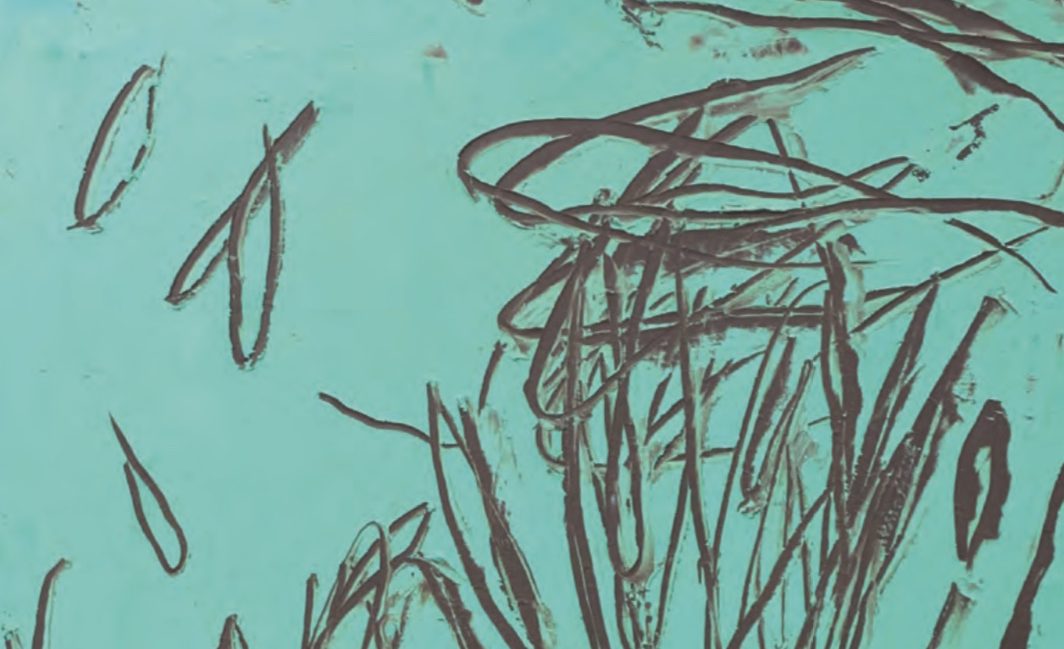
Louisa Chase: 1980 - 1985
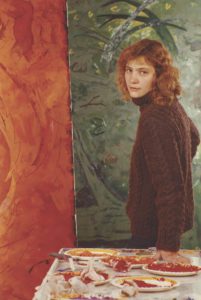 The early 1980s was a fertile time in New York City’s vibrant art scene. Louisa Chase’s career gained traction—building momentum from her inclusion in important exhibitions at the New Museum of Contemporary Art and the Whitney Biennial. After seven years of balancing teaching with studio time, she turned her focus inward to concentrate solely on her work while also meeting the demands of galleries, international exhibitions and print production. This pace remained consistent throughout her career.
Chase built a roster of notable galleries representing her work, including the Robert Miller Gallery, which was known for introducing contemporary artists onto the scene. She was also productive as a printmaker, and her bold woodcuts were widely exhibited as she worked closely with many publishers including Brooke Alexander and Diane Villani. She was included in major exhibitions in New York,
Germany, Switzerland and Japan, and made her debut in the Tampa Bay area in Currents II: A New Mannerism at the University of South Florida in 1982. Pictured here, Chase’s paintings Fire and Woods represented the United States at the Venice Biennale in 1984.
Chase’s imagery in her paintings and prints became more emotionally-charged. She incorporated stylized figures with elements found in the natural landscape such as storm clouds, vibrant sunsets, turbulent ocean waves, and fire to communicate deep-seated emotions. Inserting body parts, such as hands, torsos or feet, into a scene implied the artist’s presence, a self-portrait, of sorts. Her work explored an emotional landscape heightened by the application of thick impasto oil paint mixed with wax to achieve luminous layers of texture. She inscribed her symbolist iconography into the surface in a physical manner that evoked the same bold marks in her woodcuts, and she used universally recognizable forms as an open-ended invitation for the viewer to participate in an introspective game to decode her hidden messages.
 In 1980, Chase explained in a catalog for New Work/New York, a group exhibition at The New Museum, that her paintings are a means of recalling an elusive experience, which is often comprised of many facets, and of exploring multiple ways of expressing a single feeling. She explains, “One moment is shattered into many moments, one place into a thousand places. Their relationship and scale determine the nature of experience, a psychological cubism in which all the directions are at once being that experience, the complexities of one feeling.”
During this time, Chase began to use the landscape as metaphor to express her emotional journey and she repeatedly used the same simplified images and symbols in her vocabulary, such as embracing figures, hands and feet. When combined in different scales and color relationships, the narratives changed and represented an entirely different emotional state.
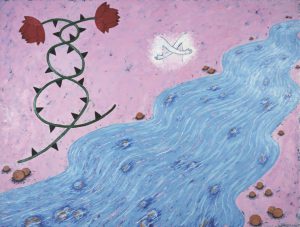
Two studies in this exhibition reveal Chase’s process as she worked out the composition and color relationships for a six-by-eight-foot oil painting titled Entwine in the permanent collection of the Baltimore Museum of Art. In these studies—an ink and watercolor study for Entwine and an untitled oil and wax painting of yellow roses—she explored the relationship and symbolism of colors, such as a white versus pink background and red versus yellow roses, to determine her message in the final painting. Chase’s “psychological cubism” is manifested in Entwine, which captures the duality of innocence established in the saccharine pink field and serene blue stream and the darker undertones of the thorny entwined red roses that dominate the foreground. This light-hearted narrative takes an unsettling turn with the stark contrast of the entangled roses’ exaggerated black thorns. The small scale of the embracing figures in the background may recall a memory from happier times.
By 1983, she struggled to find equilibrium in an environment at odds with “the self,” illustrated in her woodcut Chasm. Her stylized figures became ensnared in their environment, unable to advance or see the path ahead, which is reflected in her woodcut Thicket.
In 1985, Chase walked away from everything and canceled all of her shows to reset her direction.