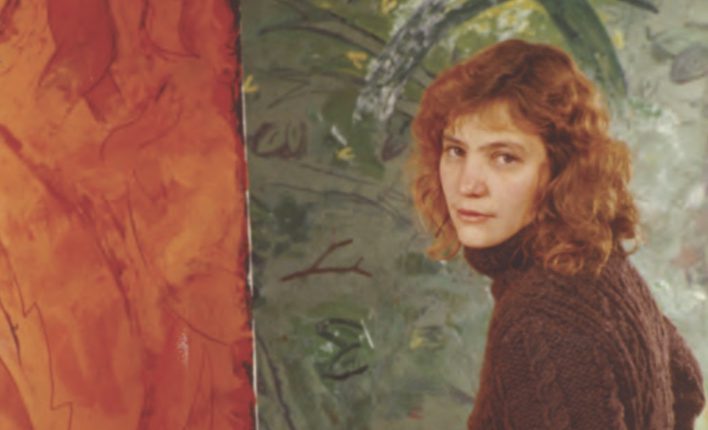
Louisa Chase: The Early Years
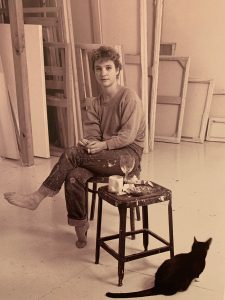
Louisa Lizbeth Chase was born in Panama City, Panama, in 1951, where her father, a West Point graduate, was stationed. The family moved to Lancaster, Pennsylvania, in 1958, where she attended a Quaker-sponsored boarding school.
Entering Syracuse University with the intention to study classics, Chase discovered printmaking through Professor Don Cortese and was influenced by social realist artists like Jack Levine, both of which laid the groundwork for her expressive style. After earning a Bachelor of Fine Arts degree from Syracuse in 1973, she honed her direction at Yale University School of Art’s prestigious graduate painting program and completed a Master of Fine Arts degree in 1975. She also explored the abstract concept of games in her paintings and sculpture through a self-defined construct of grids, preset boundaries, rules and symbols.
During her final year at Yale in 1975, Chase met resident artist Philip Guston. A major influence in the Neo-Expressionist movement, he inspired her to rethink how to approach narrative painting in a time of Minimalism and Abstraction. Chase developed a new visual language that incorporated expressive brushwork with stylized figurative elements that radiated with energetic color, applied in thick layers of high-gloss oil paint. Her focus of the game evolved into playful narratives filled with symbolism and with the human experience at its center.
Chase also had her first solo exhibition in New York City that year, which featured a sculptural installation of her “floor pieces” at Artists Space, a gallery in Soho. Degree in hand, she immediately moved to Manhattan and became a rising star in the downtown art scene in the late 1970s and throughout the 1980s. In her studio at 185 Lafayette Street, she produced a prolific body of work that explored expressive mark-making and symbolic imagery through painting and printmaking, including woodcuts. During that time, she taught painting at the Rhode Island School of Design, commuting from Manhattan to Providence from 1975-79, and at the School of Visual Arts in Manhattan from 1980-82.
From the child-like innocence of her Symbolist iconography of the 1970s, through her more aggressive gestural abstractions of the mid-1980s and beyond, Chase was in a “constant search to hold a feeling tangible.” In 1991, Chase left Manhattan for Sag Harbor, on the eastern end of Long Island, before settling in East Hampton. Throughout the 1990s and into the 2000s, she continued to explore the duality of order and chaos, physically working through her internal struggles in a fever pitch of pure color, geometry and frenetic mark-making. A diagnosis of cancer in 2010 left her struggling to find clarity in her artistic process as she grappled with the illness, but she persevered by bringing her vision full circle. Chase continued to create dynamic new work that infused the whimsical charm of her early paintings with the fervent energy of more recent work until she passed away in 2016.